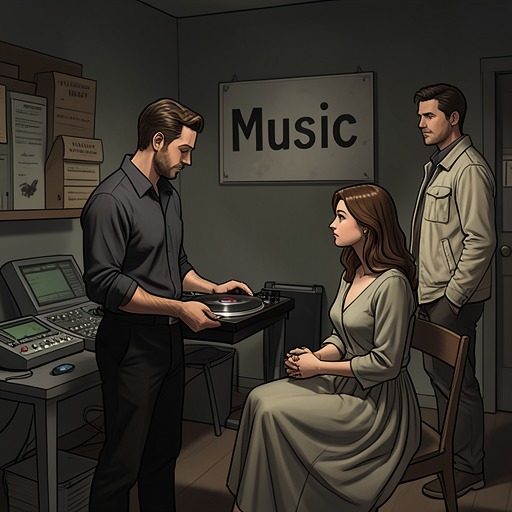
Muziek als innerlijke soundtrack
Nieuwe burenMuziek als innerlijke soundtrack is the recurring use of song lyrics and imagined guitar sound to register Peter’s changing inner state. Music first lends shape to his hope of rebuilding a life with Eva; as that hope collapses, the guitars become part of a violent fantasy, and their eventual silence leaves room for the child’s crying to reach him.
Music as hope and self-presentation
As Peter imagines Eva returning, he pictures leaving De Zonnepolder, resigning from his job, and perhaps starting something together abroad. Music enters this proposal as evidence for the future he wants to believe in: he invokes ABBA, Guns N' Roses, Pink Floyd, and The Beatles as enduring groups and, by analogy, as teams that should not be broken up. The reference turns a wish for renewed partnership into an argument that their shared life can still be made to work. Music here is not yet a threatening inner noise; it helps Peter narrate hope to himself.
The accompanying Alice Cooper song fragment offers a more exposed register. The excerpt identifies Alice Cooper’s album From The Inside, from 1978, and gives the lines “How you gonna see me now,” and “please don't see me ugly babe”. Their concern with how one will be seen sits uneasily beside Peter’s confident plans for a new beginning: beneath the proposal is an awareness of being vulnerable to Eva’s judgment. The contrast is sharpened when he arrives and sees Steef’s car beside Eva’s. The imagined partnership he has just assembled from shared plans and familiar music gives way to the belief that Eva has left him for Steef.
Guitars in the imagined confrontation
At The cottage by the pond, Peter watches Eva with Steef and experiences the scene through shock, jealousy, and humiliation. His thoughts turn to a staged suicide intended to make Eva witness his death and feel responsible for it. In that imagined scene, he pictures guitars drowning out the couple’s grief. The music is not presented as a song playing in the room: it belongs to the soundscape Peter constructs in his mind, where it can overpower even the response he expects from the people he wants to punish.
The narration makes that inward quality explicit shortly afterward: Peter registers a “cacophony of guitars” in his head. The image does more than accompany his anger. It shows his perception crowded by a soundtrack that gives his thoughts momentum and turns revenge into a scene he can rehearse. The guitars also contrast with the quiet details around him as he approaches the lit house: his own heavy breathing, a duck slipping into the water, and his feet sinking into sand. Against those small, immediate sounds, the imagined music magnifies the crisis and narrows his attention to the confrontation he believes is waiting inside.
Silence and recognition
After the violence at the cottage, Peter turns the gun toward himself. As he tries to raise it, the guitars finally die away. Their disappearance is the motif’s clearest reversal: the sound that had accompanied and intensified his imagined death no longer fills his perception. Peter begins to cry, and the child’s heartbreaking sobs become audible. Huddled beneath the kitchen counter, the child grips a stuffed rabbit; later, he puts his pacifier in his mouth and stares at Peter with frightened blue eyes.
That sound changes what Peter understands about the moment. He recognizes what he has done and sees his survival not as escape from punishment but as a sentence: he will have to live with the child’s eyes and atone. He tries to reach toward the child and to retrieve his mobile phone, but pain prevents him. Instead, he whispers an apology. The scene does not present music as a cure; the decisive sound is not a song but a child crying, which breaks through the guitars’ former dominance and makes Peter confront a life beyond his own grievance.
Narrative significance
Across these episodes, music shifts from a resource for imagining continuity to an instrument of self-dramatization, and then gives way to an uncomposed human sound. The movement is bound to Peter’s changing focus: he first uses bands to support a story of togetherness, then hears guitars inside a private performance of revenge, and finally attends to a frightened child whose presence cannot be absorbed into that performance.
The motif also marks the difference between imagined and immediate experience. Peter’s fantasy supplies its own soundtrack, even as the narrative repeatedly registers concrete sounds and objects around him. When the inner guitars fall silent, the child’s sobs, rabbit, pacifier, and gaze bring the consequences of Peter’s actions into the foreground. Music’s significance therefore lies not simply in what Peter hears, but in what its disappearance allows him to hear—and in the obligation that follows.